Friday, April 30, 2010

Spring Fling -Walla Walla


Sometimes reality exceeds your greatest expectations. On April 22nd-25th Portland Confrerie made their annual Spring Fling trip. This year the destination was Walla Walla, Washington.
This little Eastern Washington town seems like an unlikely place for a world-class wine region, but trust me it is all that and a bag of chips. Jaydene and John Chandler were our gracious hosts and with Jaydene having grown up in this area she really wanted to showcase what Walla Walla is all about.


Thursday at Gramercy
Friday morning at L'Ecole 41

The itinerary on Friday was:
L'Ecole 41, Long Shadows, Three Rivers for Lunch and lastly Northstar.


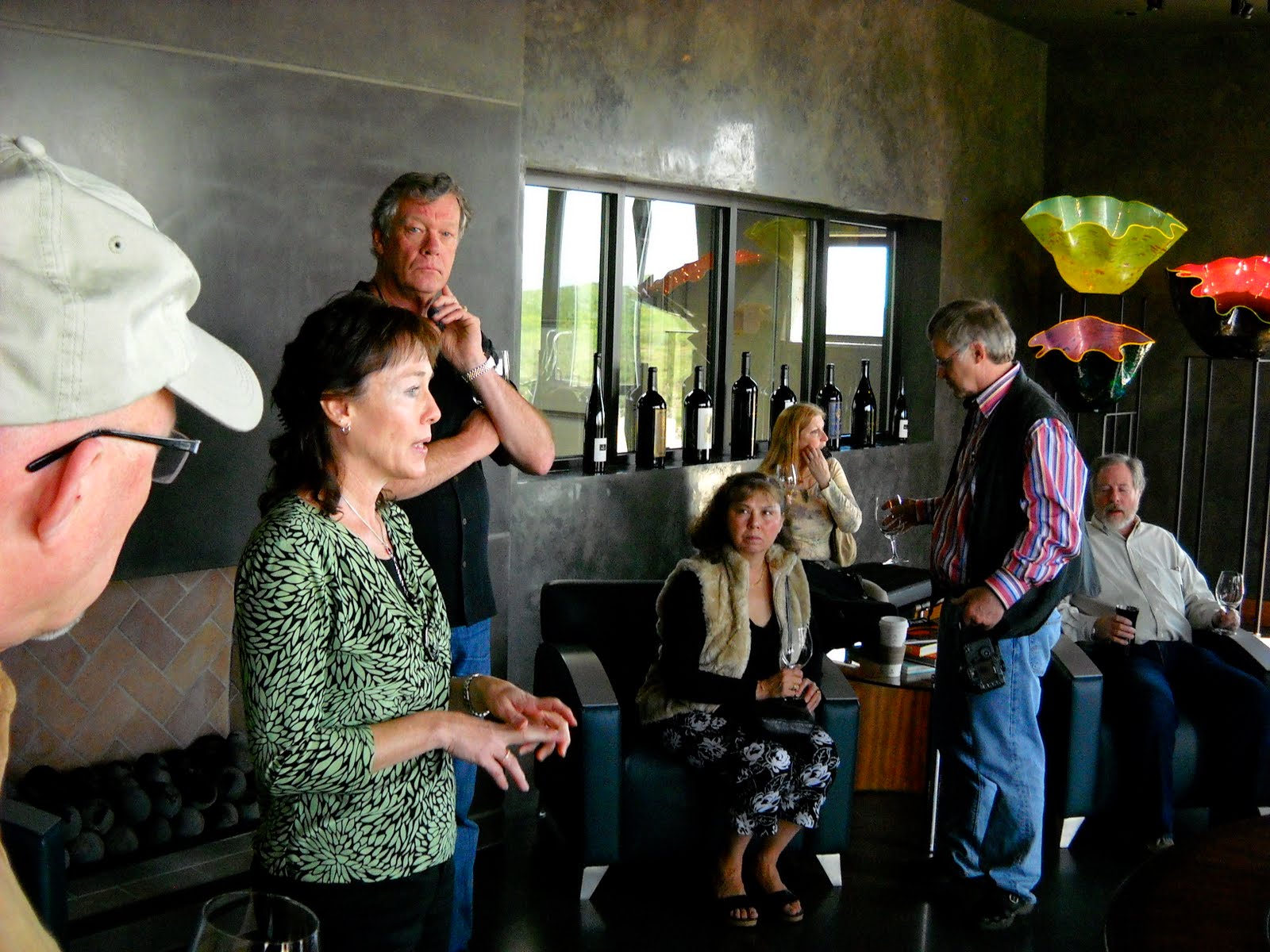
Long Shadows & Chihuly glass artwork in the background
Dale Chihuly chandelier at Long Shadows Winery

Abeja
Abeja is Spanish for Bee
Rick Isenhower at Saturday's tasting panel

The Saturday events were a visit to Walla Walla Vintners and a tasting panel later in the afternoon that brought in Rick Small from Woodward Canyon, Rick Isenhower from Isenhower Cellars, Caleb Foster of Buty and David Stevenson of Stevenson Cellars.

The evening festivities consisted of a wonderful sit down dinner for 30+ people at the historic Whitman Hotel. The entire weekend was wonderful and Jaydene and John completely outdid themselves. Thank you so much!

Sunday, April 18, 2010

Adelsheim Pinot Noir


What is better than a bottle of Adelsheim Pinot Noir? How about 10 bottles.
On March 21st this past month Portland Confrerie had a chance to sample a vertical of Adelsheim Wineries Willamette Valley Pinot Noir. We tasted the years from 1988 through 1997. Below is a bit of the history of the winery from the humble beginnings to the present. Click on the below tasting notes to see my personal take on these wines. What I appreciate about these wines is that one of the pioneering families of the Oregon wine business (David and Ginny Adelsheim) are still very actively involved with this business. The moxie that these early grape growers and wine producers had just continues to amaze me (conventional wisdom was that the Willamette Valley was too cool to produce vinifera grapes). Well, we all know how this story turned out. So, a tip of the hat to the Lett's, Adelsheim's, Erath's, Campbell's, & Fuller's for taking a big chance and leading to where we are today


Adelsheim Pinot Noir

1971

On a beautiful June day in 1971, David Adelsheim and Ginny Adelsheim stood above an open field and were taken with the beauty of its orange and purple wildflowers. Five hundred feet below, Oregon's north Willamette Valley stretched out in a patchwork of orchards, pasture and native trees. The field, rich with clay-loam soil, had a gentle southern exposure and was sheltered by the Chehalem Mountains. The Adelsheims had dreamed of planting a vineyard in the area since returning from a summer in Europe, where they were inspired by the artisanal foods and wines they encountered.

1972

In 1972, the Adelsheims began planting their original 15-acre vineyard at Quarter Mile Lane with Pinot noir, Chardonnnay, Pinot gris, and Riesling, relying on family and friends for assistance. Although the Chehalem Mountains were, at this time, an unproven viticultural area, the Adelsheims were undaunted in pursuit of their dream to produce exceptional wines in Oregon's north Willamette Valley.

1978

Working in a cramped basement winery with a simple crusher and press, and 20 Burgundy barrels, David Adelsheim made Adelsheim Vineyard's first 1,300 cases of wine for commercial release in 1978; tiny quantities of Pinot noir, Chardonnay and Riesling from the estate vineyard were produced, along with Semillon and Merlot. As the Quarter Mile Lane vineyard matured to full yield and grapes were purchased from other growers, annual production doubled every two years.

1982

As Adelsheim Vineyard continued to grow, the need for a new production facility became critical. A 6,000 square-foot winery, adjacent to the Adelsheim's home, was built in 1982. Barrels, tanks, a bottling line and still more barrels were added until this winery was also filled to capacity.

1989

The first vineyard expansion was in 1989, with the lease of a 19-acre site across the road from the original estate vineyard at Quarter Mile Lane. Today, Bryan Creek Vineyard remains an important source of Pinot noir, Pinot gris and Pinot blanc. A 52-acre site was also purchased at a lower elevation in the Chehalem Valley. Planted with Pinot gris and Burgundian clones of Pinot noir and Chardonnnay, the Calkins Lane Vineyard is also home to the current Adelsheim Vineyard winery.

1994

Co-owners Jack and Lynn Loacker joined Adelsheim Vineyard in 1994, and began planting Ribbon Springs Vineyard in 1995. This exceptional 120-acre site on the Ribbon Ridge spur of the Chehalem Mountains has provided Pinot noir and Pinot gris grapes since 1998.

1997

In 1997, a state-of-the-art, 35,000 square-foot, gravity-flow winery was completed at Calkins Lane Vineyard. Combining function with understated elegance, this 40,000 case capacity facility provides the quality controls demanded by a "hands-off" winemaking approach. A two-level, gravity-flow fermentation room allows for gentle grape movement and four underground barrel caves utilize pre-cast concrete arches and temperature-controlled floors to provide optimal temperature and humidity for slow, cool aging of their Pinot noir, Chardonnay and Syrah.

2001

Bringing with him twelve years experience in working with Pinot noir, Dave Paige joined Adelsheim Vineyard as winemaker in September of 2001. Dave provides fresh vision regarding winemaking techniques and equipment and applies great passion for balance in crafting their fruit-driven, richly-textured wines.

2006

The addition of Viticulturist Chad Vargas to the Adelsheim Vineyard team in the fall of 2006 brought a new level of intellectual ability to our vineyard operations. His BS and MS degrees in Crop Science and Plant Pathology support advances in viticulture, and thus fruit quality, leading to even further consistency and intensity in the wines we produce. His leadership in getting our estate vineyards certified under the LIVE program has put us in the forefront of vineyard operations.

2008

An extensive addition to the winery on Calkins Lane was completed in September 2008. The new facilities have given winemaker Dave Paige the ability to bring in more fruit at one time than was previously possible. Two sorting tables and extra fermentation space ensure that we always have the fermentation capacity to match harvest demands. The addition also further facilitated our ability to craft small lots that will insure a greater variety of distinctive single vineyard Pinot noirs.

2009

Our new tasting room was unveiled to the public in April 2009. For the first time in our company's history, we are now able to match the facility to the high level of hospitality, customer service and wine quality that we provide to our visitors. This well thought-out and designed space offers beautiful views of our Calkins Lane Vineyard. With an emphasis on upper-tier Pinot noirs and a tour program created to provide our guests an elegant experience, the Adelsheim tasting room is a "must visit" destination during your next stay in wine country.

TODAY

Today, the Adelsheim Vineyard estate has grown to include eleven exceptional vineyard sites in the Willamette Valley, totaling 190 acres. A new generation of experienced wine industry professionals has joined with David Adelsheim in our passionate endeavor to lead the industry in crafting consistently transcendent wines.


Monday, February 8, 2010

Feast of Saint Vincent

Doc, Cindy, Carl, Jim

On January 15, 2010 the Portland, Oregon Chapter of Confrerie de Saint Vincent des Macon held their annual Feast of St. Vincent. The event was once again held at the Oregon Culinary Institute Restaurant. The evening started off with a Champagne reception and the two wines pour were a Domain Coutier and a Droppier Special No-dosage. The guest were treated to a host of appetizers that included Prosciutto Wrapped Shrimp, Duck Pate w/Chutney Canapés, and Olivetti Crostini .


Clockwise top to bottom: Pan Roasted Duck Breast, Venison,

Braised Pork Shoulder & Seafood Ravioli


The group of 30 enjoyed entrees that included Grilled Venison, Braised Pork Shoulder, Pan Roasted Duck Breast and Seafood Ravioli.


After guest introductions and a brief background on the restaurant by their staff the group was led in its Pray of St. Vincent by Chapter Historian Doc Wilson.

The food and service were wonderful and we owe a big "Thank you" to the Oregon Culinary Institute.

A great many wines were shared throughout the night including Bordeaux from Leoville Las Cases, Grand Puy Lacoste, Pinot Noir from Adelsheim, Williams-Selyem and also some Single Vineyard Turley Zinfandel.

Saturday, January 2, 2010

2010 Schedule of Events

Greeting Portland Confrerie! We have put together a very special group of tastings for 2010.
Thanks to members who have volunteered to host tastings and also members who have volunteered for officer positions. 2010 should be a great year for Portland Confrerie.

-January-
January 15, 2010: Feast of Saint Vincent to be held at the Oregon Culinary Institute. After an enthusiastic response to our event at OCI, we are back for a second time. This is an open event (invite friends).

-February-Chateauneuf du Pape-
February 21, 2010: Chateauneuf du Pape to be hosted by Yvonne Smith. Venue TBD
This has become an annual event for Yvonne to host and we look forward to another stellar event.

-March-Argentine Malbec-
March 21, 2010: Argentina Malbec to be host by Judy Erdman and Dick Stinson. The quality to price ratio of these wines is off the chart and we look forward to seeing what Judy and Dick put together for our enjoyment.

-April-Spring Fling Walla Walla-
April 22-25, 2010: A trip to Walla Walla that is being put together by our long time members and friends Jaydene and John Chandler. If you haven't been to Walla Walla, expect to be blown away by the quality of the wines coming out of this area. There has also been some mention of a smaller group going over a day earlier to visit the Red Mountain appellation (maybe even a special visit to Blackwood Canyon) on the way over.

-May-Red Burgundy-
May 16, 2010: Red Burgundy at the home of Roger & Chris Wooley. This too has become an annual event and we look forward to another wonderful tasting of some of the best Pinot Noir on earth.

-June-Cool Climate Syrah-
June 27, 2010: Norm Schoen will be hosting a tasting of Syrah wines from cool climate locations. Syrah, much like Pinot Noir does very interesting things when not grown in a warm climate. Prepare to expect the unexpected.

-July-?-
July 18, 2010: We are exploring the possibility of a 2 day trip out the the Columbia Gorge.
Details as they develop.

-August-Initiation-
August 21, 2010 (Saturday): We have tentative plans to hold our initiation at Vista Hills Winery in Dundee.

-September-Chardonnay-
September 19, 2010: A Chardonnay tasting at the home of Kimberly Mick and Steve Lutz.
We look forward to seeing what interesting wines Kimberly and Steve pull together.

-October-Sparkling Wine-
October 17, 2010: Julie Virell is putting together a collection of Sparkling Wines (just before the holidays!). We will get a sampling of Sparkling wines from around the world and you should expect wine from unexpected places.

-November-Zin-O-Rama-
November 21, 2010: Doc Wilson and Julie Virell will host one of the favorite events of the year, the infamous Zin-O-Rama. Big, bold, juicy, high octane wines that are uniquely "American".

-December-Planning Meeting-
December 12, 2010: We head back to Arlene Harwood's boathouse for our annual planning meeting.

Officers for 2010

Chancelier -Norm Schoen

Vice-Chancelier-Steve Lutz

Treasurer-Kimberly Mick

Secretary-Robert Volz

Historian-Doc Wilson

Sargent of Arms-Dick Stinson

Thursday, July 9, 2009

Argentine Malbec


Thank you to Dick and Judy for helping me host the Argentina Malbec tasting at their house .

Argentine wine-overview
The Argentine wine industry is the fifth leading producer of wine in the world. Argentine wine, as with some aspects of Argentine cuisine, has its roots in Spain. During the Spanish colonization of the Americas, vine cuttings were brought to Santiago del Estero in 1557.
Historically, Argentine winemakers were traditionally more interested in quantity than quality with the country consuming 90% of the wine it produces (12 gallons a year per capita according to 2006 figures). In the 1990’s quality started to improve dramatically and today Argentine wines are in demand.
The most important wine regions of the country are located in the provinces of Mendoza and San Juan and La Rioja. Salta, Catamarca, Río Negro and more recently Southern Buenos Aires are also wine producing regions. The Mendoza province produces more than 60% of the Argentine wine and is the source of an even higher percentage of the total exports. Due to the high altitude and low humidity of the main wine producing regions, Argentine vineyards rarely face the problems of insects, fungi, molds and other grape diseases. This permits cultivating with little or no pesticides, allowing even organic wines to be easily produced.
There are many different varieties of grapes cultivated in Argentina, reflecting her many immigrant groups. The French brought Auxerrois, which became known as Malbec, which makes most of Argentina's best known wines. The Italians brought vines that they called Bonarda, although Argentine Bonarda appears to be the Corbeau of Savoie, also known as Charbono in California, which may be related to Dolcetto.
Torrontés is another typically Argentine grape and is mostly found in the provinces of La Rioja, San Juan, and Salta. It is a member of the Malvasia group that makes crisp, aromatic white wines and has a Spanish origin.

History
Viticulture was introduced to Argentina during the Spanish colonization of the Americas and later again by Christian missionaries. In 1541, Vitis vinifera vines were brought from Spain and planted along the Río de la Plata by the Atlantic coast (near what is now Buenos Aires. The vines did not thrive in the humid subtropical climate of the region . 1542, dried grape seeds taken from vines in Peru were planted near what is now the Salta Province east of the Andes. Eight years later another expedition from Peru brought vine cuttings. In 1556, cuttings from the Chilean Central Valley were brought to what is now the San Juan and Mendoza wine region which firmly established viticulture in Argentina. Ampelographers suspect that one of these cuttings brought the ancestor grape of the Chile's Pais and California's Mission grape. This grape was the forerunner of the Criolla Chica variety that would be the backbone of the Argentine wine industry for the next 300 years.
The first recorded commercial vineyard was established at Santiago del Estero in 1557 by Jesuit missionaries which was followed by expansion of vineyard plantings in Mendoza in the early 1560s and San Juan between 1569 and 1589. During this time the missionaries and settlers in the area began construction of complex irrigation channels and dams that would bring water down from the melting glaciers of the Andes to sustain vineyards and agriculture. In the mid 19th Century The Provencial Govenor Domingo Faustino Sarmiento, instructed the French agronomist Miguel Aimé Pouget to bring grapevine cutting from France to Argentina. Of the vines that Pouget brought were the very first Malbec vines to be planted in country.
As with many wine regions around the world the transport of the wine from the producing region to the major cities was an issue. Don Tiburcio Benegas, governor of the province of Mendoza and owner of El Trapiche wine estate, was instrumental in financing and pushing through the construction, convinced that in order for the Argentine wine industry to survive it needed a market. The 19th century also saw the first wave of immigrants from Europe. Many of these immigrants were escaping the scourge of the phylloxera epidemic that ravaged vineyards in their homeland and they brought with them their expertise and winemaking knowledge to their new home.

Climate and geography
The major wine regions of Argentina are located in the western part of the country among the foothills of the Andes Mountains between the Tropic of Capricorn to the north and the 40th parallel south. Most of the regions have a semi-arid desert-like climate with annual rainfall rarely exceeding more than 10 inches a year. In the warmest regions (such as Catamarca, La Rioja, San Juan and the eastern outreaches of Mendoza, summer temperatures during the growing season can be very hot during the day with temperatures upwards of 104°F. Nighttime temperatures can drop to 50°F creating a wide diurnal temperature variation. vines.
Some of the warmer regions can see an average of 320 days of sunshine a year.
The Andes Mountains are the dominant geographical feature of Argentine wine regions, With the snow capped mountains often serving as a back drop view in the vineyards. As winter time snow starts to melt in the spring a intricate irrigation system of dams, canals and channels brings vital water supplies down to the wine regions to sustain viticulture in the dry, arid climates. Most of the wine regions are located within the foothills of the Andes and recent trends have saw a push to plant vineyards on higher elevations closer to the mountains. The climate in some of these regions can be more continental and less prone to extremes in temperatures. Soils throughout the country are most alluvial and sandy with some areas having substrates of clay, gravel and limestone. In the cooler Patagonia region, which contains the winemaking provinces of Río Negro and Neuquén, the soil is more chalky.

I think we all learned why this previously French varietal grape has made a home and a name for itself in Argentina.
We learned that Malbec wines typically share these characteristics: ripe black fruits, such as plum and blackberry; peppery notes; earthy; firm tannins; ample acidity; conducive to oak aging. In other words, a flavor profile that may be somewhere between California Cabernet Sauvignon and California Merlot. These wines pair well with beef
The Malbec wines called “Cahors” tend to be more inky, more earthy, and a bit more tannic. The Argentine examples tend to be riper and more jammy (though there are some “old school” Argentine wineries that go more toward the rustic side).


Starter Wines
2008 Zolo-Torrontes-Mendoza, 87 pts. WA: Brilliant yellow color with marked green touches. Aromas are delicate and intense where tropical fruit and flowers predominate.
2008 Dominio del Plato-“Crios de Susan Balbo”-Torrontes –Mendoza, 90pts. WA: Alluring perfume of Spring flowers, peach, apricot and a (big) hint of citrus. On the palate the wine is dry, smooth textured, layered and succulent while retaining a sense of elegance.

First Flight (Old World vs. New World)
2005 Chateau Pineraie Cahors-3 Stars Decanter: Opulent violet damson aroma. Smooth attack. Vibrant fruit on mid-palate. Tightly knit, well balanced. Long finish. Drink 2009-14." -Decanter Magazine, 3 Stars, Best Value Cahors
2007 Dona Paula-Malbec-Mendoza-90pts. WS & WA: Opaque purple color, a brooding black fruit bouquet, with warm currant paste, cocoa powder and Turkish coffee notes backed by solid grip of the fleshy finish. Drink now through 2016

Second Flight (Focus on Mendoza)
This group of six wines should show these characteristics: ripe black fruits, such as plum and blackberry; peppery notes; earthy; firm tannins; ample acidity. To be labeled as Malbec in Argentina the wine is required to have 80% Malbec content.

2006 Vina Alicia Paso De Piedra Malbec-91 pts WA: "It begins with the dark ruby-colored 2006 Paso de Piedra Malbec. The expressive bouquet offers up cedar, tobacco, red cherry and black raspberry leading to a forward, elegantly-styled wine. Impeccably balanced, the wine has complex flavors, ripe tannin, and a lengthy finish. 100% Malbec Drink it from 2010 to 2018."

2006 Luigi Bosca Reserva Malbec-Mendoza-90pts ST: "Full ruby-red. Musky, vinous aromas of blackberry, mocha, espresso and tobacco. Suave, juicy and palate-coating, with a distinctly saline element adding complexity to the flavors of raspberry, tobacco, smoke and green olive. Finishes with fine-grained tannins and lovely aromatic lift. A distinctly soil-inflected wine with loads of personality-and an excellent value."

2006 Lagarde Malbec Single Vineyard-90 pts WA: "The dark ruby-colored 2006 Malbec DOC was sourced from a vineyard planted concurrently with the founding of the winery 111 years ago. With replanting, it now averages 70 years of age. It exhibits an enticing bouquet of cedar, tobacco, spice box, black cherry, and black raspberry. On the palate it is medium to full-bodied with good density, lingering, savory flavors, and a fruit-filled finish. It will evolve in bottle for 3-5 years and drink well through 2020."
2006 Mapema Malbec-Mendoza-90 pts WS: "Ripe and forward, with dark licorice, fig, currant preserve and chocolate notes riding along round, rich tannins. Rock-solid finish. Drink now through 2010. 2,000 cases made."

2007 Susana Balbo Malbec-Mendoza-91 pts WA: The purple-colored 2007 Malbec contains 10% Cabernet Sauvignon while receiving the same elevage as the 2006 Cabernet. It reveals an enticing perfume of coffee/mocha, baking spices, violets, black cherry, and black raspberry. Smooth-textured, layered, and ripe, it has loads of succulent fruit, enough structure to evolve for 1-2 years, and a lingering, fruit-filled finish. Drink it over the next 6-8 years."

2006 Bodega Coloma Malbec-Mendoza-92 pts WS: "Very inviting, with crushed plum and boysenberry aromas followed by a very lush textured palate of warm figs and currant paste backed by mouthwatering hints of mesquite, mineral and Turkish coffee. Long finish really holds your interest. Drink now through 2011.
Click photo to enlarge
Personally I thought these wines went well with food and the intensity of fruit and structure reminded me of a cross between an Austrailian Shiraz and a burly Petite Syrah. Did anyone not have a black tongue when this tasting was over?

The Prime Rib Roast was a fun addition to the food portion of this tasting and everyone’s side dishes-salads, potatoes, appetizers were stellar-thanks for the effort!

White Burgundy


A big “Thank you” goes out to Roger and Chris Wooley for hosting out May Confrerie White Burgundy tasting.

Roger Wooley gave a brief overview of the Burgundy region and where the wines we were tasting were from. Also, John Montegue was kind enough to speak to what we should look for in these wines as well.

White Burgundy wines are 100% Chardonnay. These wines are full of character and I have heard them referred to as: “The red wine of white wine”. Our starter wines were from the Chablis region of Burgundy.

This is a brief break down of the regions of Burgundy that we tasted.

Chablis: Chablis will have a very pale straw color often with a tinge of green. It is grown on a Jurassic clay and limestone soil called Kimmeridgian that is laden with exogyra virgula (a comma-shaped fossilized mollusk), which lends a defining gout de la pierre a fusil, or gunflint character, to the wines. Chablis is light- or sometimes medium-bodied, but in any case deceptively powerful. The wines have mouthwatering acidity, almost saline in nature, and can age extremely well.

Chassagne-Montrachet: In general these wines are feminine, but not in a girlish sense. Chassagne-Montrachet is usually fuller than its counterparts from Puligny-Montrachet and usually features more densely concentrated fruit.
They are mature, complex and sophisticated with depth and character. There are ripe yellow and green fruits, good spice and perhaps a touch of white flowers.
Puligny-Montrachet: What makes Puligny-Montrachet so special? More than anything else it is the balance and harmony. The result is a finesse and breed that sets Puligny-Montrachet apart. In addition, Pulignys are noted for having a steely, vibrant core in the very center of their flavors. When young, they are lean and hard, but the balance of elements allows aging (6 to 8+ years for a 1er Cru) and consequently the wines develop great complexity.

Meursault: In most cases, Meursault despite an almost olive-oil texture is countered by a precise mineral character, stoniness and a more refined overall palate than, for instance, Chassagne-Montrachet. It shows the unique stony/mineral character that often gets lost when tasting Meursault, as many concentrate on the ripe, hedonistic primary flavors and aromas. It shows the bipolarity of the wine, the interplay of both factors, that makes Meursault one of the most sought after white wines in the world.


We began our tasting with:

Starters
1. 2005 Simonnet-Febvre Chablis
2. 2005 Ch. de Beauregard St. Veran Classique

Flight #1 –Sampling the 4 different area of Burgundy-2006 Vintage
1. Chablis: Louis Michel Montee de Tonnerre 1er Cru
2. Chassagne Montrachet: Pillot Vergers 1 er Cru
3. Puligny Montrachet: Carillon
4.
Meursault: Remoissenet Pere & Fils Cuvee Maurice Chevalier

Flight #2-Sampling of 3 consecutive years of Meursault (Not same vineyard)
1. Matrot Blagny 1er Cru 2004
2. Boillot Meursault 2005 3. Matrot Chevalier 2006

Flight#3 2006 Puligny Montrachet, Single producer- 3 separate vineyards.
1. Giradin Champgains 1er Cru
2. Giradin Referts 1er Cru
3. Giradin Vielles Vignes (Old Vines)


The first flight was meant to show the regional differences in the wines from four distinct regions in Burgundy.

Our second flight profiled Meursault. The most common descriptors attached to Meursault are hazelnuts, honey and vanilla for its aromas and creamy for its texture.

The final flight from Puligny Montrachet showed what a single producer can do with fruit from different vineyards, but from within the same region. The wines were concentrated with a depth of fruit and minerality. This would be a fun (expensive) flight to taste in 10 years.

Monday, March 30, 2009

Chateauneuf du Pape


Once again, a big "Thank you" goes out to Yvonne Smith for
hosting the March Confrerie event. The wines were very nice and we all
gained more insight as to why The wines from Chateauneuf du Pape have been gaining respect from around the world.

The event began a 3:00pm with the starter wine and about 45 minutes later the formal tasting began. Guests were introduced and we want to say how nice it was to see Jack Duey back in our midst

After an update of our upcoming Spring Fling to Southern Oregon by Lis Cooper we were treated to some wine education by our very own Doc Wilson.
Doc Wilson was kind enough to give us a brief overview of the appellation and the grapes used in the production of the white and red wines of Chateauneuf du Pape.

Châteauneuf-du-Pape translates as "New Castle of the Pope," and indeed, the history of this commune and its wine is firmly entwined with papal history. In 1308, Pope Clement V, former Archbishop of Bordeaux, relocated the papacy to the city of Avignon. Clement V and subsequent "Avignon Popes" were said to be great lovers of wine and did much to promote it during the seventy-year duration of the Avignon Papacy. At the time, winegrowing around the town of Avignon was anything but illustrious. While the Avignon Papacy did much to advance the notoriety of Burgundy wines, they were also promoting viticulture of the surrounding area, more specifically the area 5–10 km north of Avignon, close to the banks of the Rhône River. Prior to the Avignon Papacy, viticulture of the area had been initiated and maintained by the Bishops of Avignon, largely for local consumption.
Clement V was succeeded by John XXII, who regularly drank the wines from the vineyards to the north, as well as Burgundy wine, and did much to improve viticultural practices there. Under John XXII, the wines of this area came to be known as "Vin du Pape"; this term later became Châteauneuf-du-Pape. John XXII is also responsible for erecting the famous castle that stands as a symbol for the appellation.

The village and three other surrounding communes produce wine, and Châteauneuf-du-Pape is an Appellation d'Origine Contrôlée (AOC) in the southern Rhône wine region. Unlike its northern Rhône neighbors, Châteauneuf-du-Pape permits thirteen different varieties of grape; the blend is usually predominantly Grenache. Other red grapes include Cinsault, Counoise, Mourvèdre, Muscardin, Syrah, Terret Noir, and Vaccarèse. White grapes include Grenache Blanc, Bourboulenc, Clairette, Picardin, Roussanne, and Picpoul. In recent years, the trend has been to include fewer (or even none) of the allowed white varieties and rely heavily (or solely) upon the Grenache, Mourvedre, and Syrah. One may suspect that this is a response to international wine-market trends and the desire to have this sometimes-rustic wine appeal to a broader commercial audience.
Before wine critic Robert M. Parker, Jr. began promoting them, the wines of Châteauneuf were considered rustic and of limited appeal in the U.S. However, his influence increased their price more than fourfold in a decade. In gratitude, the Châteauneuf Winemakers Union pushed for his becoming an honorary citizen of the village.

These wines are wonderful with food and they offer incredible layers of fruit, smoked meat, garrigue, earth, stone, and animal scents and flavors. You will hear the terms "rustic", "brooding" and maybe even "backward" when these wines are described, but you will certainly know you aren't drinking a Two-Buck Chuck when you enjoy these wines. What they may lack in polish and finesse, they more than make up for in complexity, interest, structure and intensity. While there are 13 grape varietals allowed for the production of red Chateauneuf du Pape, typically the blend of grapes is heavy on the Grenache and then followed by equal parts Mouvedre and Syrah and maybe some trace percentages of Cinsault.

We began our tasting with:

Telegraphe Chateauneuf du Pape Blanc 2006 – The production of white wines in Chateauneuf du Pape is limited and this estate makes a very balanced, savory white wine that is food friendly and free of any apparent new oak barrel aging (typical for the appellation).
Telegramme Chateauneuf du Pape Rouge 2006 –Tight, tart fruit with spice on the nose. This blend of 90% Grenache and 10% Mouvedre garnered a score of 88 pts. from Wine Spectator.
Chante Perdrix Chateauneuf du Pape Rouge 2006 –Ripe purple fruit, medium bodied with a hint of black licorice and a long finish. The wine is a blend of 80% Grenache with the balance being made up of Syrah, Mouvedre and Muscardin.
Mas de Boiszulan Chateauneuf du Pape Rouge 2006 – A savory nose, purple fruit, licorice and a wine with good structure and aging potential. This is a blend of 75% Grenache, 15% Syrah and 10% Mouvedre and it was given a 91pt. score by Wine Spectator.

Domaine Lucien Barrot Chateauneuf du Pape Rouge 2005- A grapey nose with a savory-thyme/garrigue note. Good balance and the wine is a blend of 80% Grenache and 20% Syrah. Wine Spectator gave this 93pts.
Perrin Sinnards Chateauneuf du Pape Rouge 2005- Smokey nose with great red/purple fruit showing through. Well balanced with a bit of barnyard showing on the finish. This wine is a blend of 70% Grenache, 15% Syrah, 15%Mouvedre and is scored 92 pts. in Wine Spectator and a 91 by Parker.
Galet de Papes Viellies Vignes Chateuneuf du Pape Rouge 2005- Red fruit showing through-raspberry and black pepper-yum! This is a blend of 60% Grenache, 30% Mouvedre and 10% Syrah……….I would have guessed the Syrah component to have been higher. 92pts. by Steven Tanzer.

Vieux Telegraphe “La Crau” 2006- 93 points Wine Spectator: " very grippy style, with lots of sweet tapenade, tobacco, hot stone and braised chestnut notes weaving through a core of dark currant and fig fruit. There's a nice twinge of lavender on the structured finish. For the cellar. Best from 2010 through 2028." (11/08) 92 points Stephen Tanzer's International Wine Cellar, Jan/Feb 09: Vivid red. Impressively complex bouquet of raspberry, dried cherry, garrigue and flowers. Exotic apricot and floral honey notes come up with air and carry onto the palate, which shows sweet red fruit flavors, a smoky quality and a velvety texture. This very elegant wine is already putting on a seductive show. Finishes smooth, juicy and very long." 92+ points Robert Parker (10/08) 14.5% abv.

Chateau Beaucastel 2006- Robert Parker says: Dense plum/ruby/purple color is followed by a big, sweet perfume of black truffles, camphor, earth, incense, new saddle leather, and loads of peppery, blackberry, and herb-infused, meaty, black cherry fruit. Deep, full-bodied, and dense, with sweet tannin, this explosively rich Chateauneuf is a stronger effort than the 2005, 2004, or 2003. Anticipated maturity: 2012-2028." 95 pts.

After the tasting the group set up a potluck supper and dishes including a Roasted leg of lamb, meatballs, pasta, a rich buttered rice dish, assorted salads and cheeses were served.

As promised I have included a description of the term “Garrigue”.

To understand the term "garrigue" I think the following description by Daniel Brunier (owner of Vieux Telegraphe) is very apt, he says:

“The garrigue. That’s the place where nothing else will grow. It is the domaine of the wild lavender, wild rosemary, and scrub oak. It is a place austere and hospitable at once. With nothing more than your nose, you’ll know you are there! But if is is possible to stretch out on the ground without getting jabbed in the back or rear end, you are not really in the garrigue, because in the true garrigue, you’d need to find a flat rock just to sit down. The garrigue smells so good, I can smell it just thinking about it. And in the summer heat, if you piss in the garrigue it is as if you had prepared an herb tea. It is so fragrant, but the garrigue is never silent because it is teeming with life.”