CALANDER 2008:
January 27, 2008 6:00 P.M. Feast of St. Vincent, Governor Hotel, Hosts: Steve Lutz and Kimberly Mick
February 17, 2008 3:00 P.M. O House, Lake Oswego, Host Yvonne Smith, Wine Chateauneuf du Pape
March 16, 2008 3:00 P.M. Place TBD, Host James (Doc) Wilson, Wine New Zealand
April 20, 2008 3:00 P.M. Roger Wooley Home, Wine White Burgundy
April 27 through May 13th Spring Fling, Bordeaux France: Host Steve Lutz and Kimberly Mick
June 22, 2008 3:00 P.M. (Moved to the fourth Sunday in June in honor of Fathers day) Place Burdigala, Host Mark Lindau/Steve Lutz, Wine Red Burgundy
July 20, 2008 3:00 P.M. Place Jack and Eileen Hines, Host Julie Virell and Arlene Harwood, Vine German Rieslings
August 17, 2008 1:00 P.M. August Initiation, Erath Vineyard, Host Dick Stinson
September 21, 2008 3:00 P.M. Place, the Home of John and Jaydene Chandler, Wine Pinot Noir
October 19, 2008 3:00 P.M. Place, the Home of John and Jaydene Chandler, Wine Easter Washington Wines
November 16, 2008 3:00 P.M. Place, the Home of Dick Stinson and Judy Erdman, Host Dick and Judy and Julie Virell, Wine Port
December 14, 2008 3:00 P.M. December Planning Meeting, Host Carey Sundeleaf, Wine Champagne
Thursday, June 12, 2008

Monday, April 28, 2008
White Burgundy

Once again, a big "Thank you" goes out to Roger and Chris Wooley for hosting the April Confrerie event. The wines were very nice and I think we all gained some more insight as to why these wines are so prized around the world.
 Doc Wilson
The Chardonnay grape is arguably the widest planted vinifera grape varietal in the world. This grape is grown world-wide and the wines produced from it can often be called: "winemakers wine" due to its ability to reflect what the winemaker does in the cellar.
The physical and spiritual home of Chardonnay though is the Burgundy region of France. The true origin of this grape is somewhat suspect, but it appears that it dates back to Roman times and that the grape is a cross between Pinot Noir and Gouais Blanc. Whatever the origin, this grape is being grown around the world. Chardonnay has the reputation of being hardy, adaptable and it grows with relative ease in a wide variety of climates. The "new world" style Chardonnay wines have a very ripe, almost tropical fruit component. Australia and California wines often show this trait. They also tend to have a buttery, oaky (vanilla) edge. The "buttery" component is due to malolactic fermentation which converts malic acid into the softer tasting lactic acid. The use of new oak barrels contributes a vanilla component to the wine, but it can also add hints of baking spices or even a toasted bread quality.
This past Saturday I had a chance to sample 11 Chardonnay wines from Burgundy. The wines were good examples of terroir driven wines. The winemakers used a minimal intervention approach (i.e. , the wine is made in the vineyard). Below is the line-up and my tasting notes.
While the above description and the attached tasting notes may seem a bit pretentious, the reality of these tasting are they are much less formal than it would appear and there is substantially much more "drinking" vs. "tasting" going on. As one of my friends says: "Wine, it's not brain surgery"
The "starter" wines of the afternoon were two Chablis wines.
Simonnet Febvre Chablis Millesime-2004: Mineral nose, tart citrus fruit with a nice minerality on the palate.
Simonnet Febvre Chablis Millesime-2005: Toasty nose, softer citrus fruit. I much preferred the 2004 vintage.
The first flight were three Bourgogne's. These wines are basic "table wines" by their designation, though they cost around $30.00/bottle.
Etienne Sauzet-Bourgogne 2005: Mineral nose, citrus fruit and honey on the palate. Nice clean finish.
Henri Boillot 2005: Smoke and oak on the nose, crisp fruit, dry finish.
D. Denis Mortet 2005: Mineral nose, minerally palate with crisp lemon/citrus fruit.
 Jan Cullivan & Guest, John Montague & Guest
The second flight were three wines from Meursault. The Wikipedia entry says about Meursault:
Meursault is an Appellation d'origine contrôlée (AOC) situated in the Côte de Beaune subregion of the Burgundy wine region. It lies along the foot of the Cote-d'Or escarpment, around Beaune and with the broad Saône valley plain to its east. Meursault produces mainly white wines from Chardonnay grapes, primarily in a style with a clear oak influence, which have led to descriptions such as "buttery" to be applied to powerful examples of Meursault wines. Within the Meursault AOC there are some Premier Cru vineyards, but no Grand Cru. This has however not stopped the wines from Meursault from competing with the white burgundies from the villages Chassagne-Montrachet and Puligny-Montrachet, where several Grands Crus are situated.
The three wines in this flight were:
Guy Bocard - Meursault-Charmes 2004: Citrus on the nose with a hint of toast.
Guy Bocard - Meursault/ Le Narvaux 2004: Herbaceous nose, creamy mid-palate and a soft finish.
Guy Bocard - Meursault-Vielle Vignes (old vine) 2004: Complex honey/perfume nose, bright, crisp fruit with a creamy finish.
The last flight of the night was two wines from Puligny-Montrachet. The wines from Puligny-Montrachet have a complex minerality. The two wines in the flight were:
Louis Carillon - Puligny-Montrachet 2005: Savory nose and palate, bright lemony fruit, long finish.
Louis Latour - Puligny-Montrachet-"Sous Le Puits" 1st Cru 2005: A lively, with pleasant freshness, slight woody notes on the nose, more mineral. Citrus aromas of lemon, are first noticed, leading into more vegetable ones, fresh cut grass and menthol.
The last wine I tasted (since I was sitting next to Sam Sundeleaf who brought this wine to share after the "real" tasting) was:
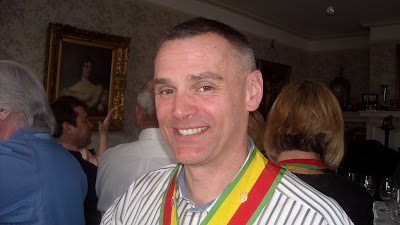 Sam Sundeleaf
Meursault is an Appellation d'origine contrôlée (AOC) situated in the Côte de Beaune subregion of the Burgundy wine region. It lies along the foot of the Cote-d'Or escarpment, around Beaune and with the broad Saône valley plain to its east. Meursault produces mainly white wines from Chardonnay grapes, primarily in a style with a clear oak influence, which have led to descriptions such as "buttery" to be applied to powerful examples of Meursault wines. Within the Meursault AOC there are some Premier Cru vineyards, but no Grand Cru. This has however not stopped the wines from Meursault from competing with the white burgundies from the villages Chassagne-Montrachet and Puligny-Montrachet, where several Grands Crus are situated.
The three wines in this flight were:
Guy Bocard - Meursault-Charmes 2004: Citrus on the nose with a hint of toast.
Guy Bocard - Meursault/ Le Narvaux 2004: Herbaceous nose, creamy mid-palate and a soft finish.
Guy Bocard - Meursault-Vielle Vignes (old vine) 2004: Complex honey/perfume nose, bright, crisp fruit with a creamy finish.
The last flight of the night was two wines from Puligny-Montrachet. The wines from Puligny-Montrachet have a complex minerality. The two wines in the flight were:
Louis Carillon - Puligny-Montrachet 2005: Savory nose and palate, bright lemony fruit, long finish.
Louis Latour - Puligny-Montrachet-"Sous Le Puits" 1st Cru 2005: A lively, with pleasant freshness, slight woody notes on the nose, more mineral. Citrus aromas of lemon, are first noticed, leading into more vegetable ones, fresh cut grass and menthol.
The last wine I tasted (since I was sitting next to Sam Sundeleaf who brought this wine to share after the "real" tasting) was:
 Sam Sundeleaf
Michel Colin-Deleger & Fils - Saint-Aubin- 1st Cru "Les Combes" 2003: Big, powerful, toasty new-oak nose. Lots of nuttiness . The palate is very cool and classy. There is lovely clear orchard fruit and a definite mineral acidity. Juicy fruit, and really quite long and fine finish.
 Jay F. & Guest-Photo: Courtesy of John Montague
 Jay F. & Guest-Photo: Courtesy of John Montague
All of these wines were nice and these are definitely "big boy" Chardonnay wines with the prices to go with them. The wines in the 2nd and 3rd flight would retail between $40-70/btl. These are wines that you want to share with people who would appreciate them.
Tuesday, April 8, 2008
Feast of St. Vincent
Here is a digital copy of the group photo taken at the 2008 Feast of St. Vincent.

Top row: Mareesa Elquist, Shale Macks, Doctor Mark, Larry Walters, John Chandler
2nd Row: Doc Wilson, Arlene Harwood, Richard Stinson, Norm Schoen, Kathryn Daly, Beth Collins, Judy Erdman, Stephen Lutz
Bottom row: Kimberly Mick, Cindy Farrar, Kerri Sundeleaf, Jayden Chandler, Sharon House, Laurie Stoddard, Yvonne Newman, Olivia Walters
Held in the Rennaisance Room at the McGovern Hotel, Portland ,OR, January 27th, 2008. Saint Vincent Celebration
Portland, Oregon Chapter
Confrérie des Vignerons de Saint-Vincent de Mâcon
Wednesday, March 19, 2008
March 2008 New Zealand

Once again we were back at Vino Vixen's for our March Event. Our host was Doc Wilson and this month we sampled some stellar wines from New Zealand. Doc brought as a guest Ray Walsh who is a Kiwi and who is also the owner/winemaker for Capitello Wines.
In 1993 Ray was recruited as Cellar Master by King Estate, one of Oregon's largest producers, at the start of their operation. With all the new technology, techniques and toys at his disposal, Ray was right where he needed to be to become a master of his craft.
Then, in 1999, Ray was named Winemaker for King Estate! His career went straight up. But while successful professionally, his son Desmond wasn't getting as much Dad-time as Ray wanted. Ray found a rare opportunity to combine his loves into an ensemble of good vibes and great wine.
Since 2003, Ray and Desmond are partners in the latest family adventure, Capitello Wines. Between French emersion classes for Desmond and summers in New Zealand surfing, bungee-jumping, sky and scuba diving, they have found time to create some of the best Pinot Gris, Pinot Noir and Dolcino in the state of Oregon. They have crafted a family legacy already two generations strong with a reputation for improvisational skill, call, honesty and integrity.

We started the event with two crisp New Zealand Chardonnay's. One of the wines was a 2004 Sacred Hill, Whitecliff from the East Coast Appellation. The wine showed some earthy complexity on the nose and this was very crisp, with green apple and maybe a touch of lime fruit. I am guessing this wine was
The other was a Monkey Bay that was a little less crisp
fermented in stainless and did not undergo malolactic fermentation.
The other was a Monkey Bay that was a little less crisp

 Photo: Doc Wilson & Ray Walsh

We poured 4 Sauvignon Blanc wines for the first flight. Two of the wines were 2006 vintage and even that short amount of time in the bottle added some richness.
Sauvignon Blanc wines will typically have a grassy, herbaceous nose, bright citrus (lime, lemon, grapefruit) fruit and they are very food friendly because of their acid levels. These wines aren't typically aged, but an older Sauvignon Blanc will tend to develop an asparagus nose...replacing that grassy nose that we identify this wine by.
The first group of wines included:
1. 2006 Huia: Herbacious nose, hint of bell pepper, spice, cayenne. Bright, tart citrus fruit. A well balanced wine.
2. 2006 Capitello: Rich nose, tart lime with a hint of grapefruit. This wine has nice balance and a great body. The mouthfeel has very rich & opulent texture due to a portion of the wine seeing aging in neutral French barrels. This was my favorite.
3. 2007 Kim Crawford: Grassy nose, bright, zesty, citrus fruit with good balance and body.
This winery is a renowned producer and it doesn't appear to be sitting on its laurels.
4. Cloudy Bay: Herby nose, tart citrus fruit with a lighter body and a zesty finish.
The second flight consisted of 5 New Zealand Pinot Noir wines. The line-up included:
1. 2004 Martinborogh: Rich, earthy, minerally nose, ripe fruit with touches of blueberry and plum. Good body and finish. I guessed this was an Oregon "ringer"-I was wrong!
2. 2004 Tekairanga: Mineral nose with a whiff of pepper. Very bright red fruit on the palate. This would be a good food wine.
3. Craggy Range: Earthy nose, bright, tart pomegranate, cranberry fruit.
4. 2004 Peregrine: Funky earthy nose, big purple fruits with a touch of pepper.
5. 2005 Villa Maria: Garnet colored, ripe strawberry fruit that was big, yet balanced and elegant.
Thanks again to Doc Wilson, our special guest Ray Walsh and our host venue Vino Vixens for helping to put together such a wonderful event.
Next month we are at the Home of Roger & Chris Wooley for White Burgundies. Roger always puts together a great event so mark your calendar for April 20th. More to come later!
Salut-
Norm Schoen -Chancelier
February Confrerie Event

Greetings to all who attended the February Confrerie event held at the Oswego Lake House.
We all owe a huge "thank you" to Yvonne Smith (member and Sommelier at our February venue). We tasted Chateauneuf du Pape wines from the Southern Rhone region of France.
These wines are typically a blend of Grenache, Mouvedre and Syrah. In this appellation there are 13 grapes allowed to be used in the production of the wines. My understanding is that only Chateau Beaucastel uses all 13 grapes (Vaccarèse anyone?).
This month the tasting was a bit unusual in that we were able to sample these wines with food.
As is often the case wine goes hand in hand with food and it was a nice example of how to pair food and wine. The 2003 vintage of Chateauneuf du Pape was a very warm year and the wines should be ripe. The 2005 vintage is a top notch year and definitely a vintage to stock up on wines. Though the dollar is at a 30 year low, there are some good wines to be had from CDP in 2005 at a good value.
In case you didn't bring home the tasting notes that Yvonne put together I am including the professional tasting notes (with a few of my own comments in italics).
Wines tasted
2005 Vieux Telegramme rouge: 2005 Domaine Lucien Barrot et Fils: Fresh red berry and cherry aromas with a subtle floral quality adding complexity. This wine is also the "second label" of Vieux Telegraphe. Their View Telegraphe is 65 % Grenache with 15% Mouvedre & 10% Syrah with the remainder made up of the allowed "odd-ball" grapes of CDP. The Telegramme is 100% Grenache and is meant for immediate drinking. I picked up some tart cherry fruit along with some spice on the nose. The wine finishes with fairly rustic tannnins.
2005 Domaine Lucien Barrot et Fils: Intensely floral aromas of fresh strawberry, red currant, lavendar and exotic dried apricot. Bright, juicy, and persistent. An excellent example of traditionally styled CDP. I picked up on the floral aspect of this wine along with the concentrated fruit and a savory component. This wine also had great structure and it should age very well. This was my favorite wine of the night.
2003 Chateau La Nerthe: Spicy, jammy aromas of blackberry, cassis and exotic spices. Round and velvety with sweet berry flavors and notes of chocolate, mocha and lavendar pastille. I picked up cassis and a concentrated, full throttle cherry fruit, maybe even leaning into cherry liquor. Great mouthfeel.
2005 Chateau Perrin et Fils: This is the second label for Chateau Beaucastel. This wine exhibits greater ripeness than the 2006 but a longer and more complete mouthfeel. Terrifically concentrated and richness for what essentially is a declassified young vine Beaucastel cuvee blened with another parcel. Rich fruit, good structure, not much character.
2005 Domaine de l Cote de l'Ange: A gutsy, structured style, with lots of fig, black currant, braised chestnut, bittersweet cocoa and espresso notes carried by robust but ripe tannins. The finish is long and smoky. I picked up a dried fruit-fig fruit character to go along with rustic tannins.
Menu
-First Course-
Chevre and tomato salad
-Second Course-
Salmon mousse crepe finished with dill beurre blanc
-Third Course-
Tenderloin pork roasted w/sauteed onions and Roquefort cheese sauce
-First Course-
Chevre and tomato salad
-Second Course-
Salmon mousse crepe finished with dill beurre blanc
-Third Course-
Tenderloin pork roasted w/sauteed onions and Roquefort cheese sauce
A special bonus was that Yvonne brought out a selection of Red Burgundy wines from several vintages. These wines were remaining from an earlier tasting and were a great selection of village, single vineyard and Premier Cru wines
Once again, a big thank you to Yvonne Smith and the Oswego Lake House.
Zin-O-Rama

The November tasting for The Confrerie des Vignerons de St. Vincent Macon was held at Vino Vixens located at 2929 SE Powell Blvd. Sure, a wine shop next to a bowling alley seems kinda funky, but this is a very cool shop with a great space for tasting events.
So, a great space, 32 participants and 9 great wines and what does that mean? It means a very exceptional monthly event, which by the way was hosted by Sam "I am REALLY serious about Zinfandel" Sundeleaf. Thanks Sam!
The stellar line-up of Zinfandel is as follows with my tasting notes and my scoring and price per bottle. Keep in mind that taste is subjective and opinions varied greatly on this tasting. If you feel strongly about my notes, please comment.
2005 Turley Old Vine: Astringent, peppery, a hint of raisin/dried fruit. A long finish (5) $27.75
2005 Mauritson-Rockpile: Big alcohol on the nose, sweet, almost port-like. A vanilla aftertaste and on the second tasting I was getting some "stemmy" aftertaste. (9) $38.84 Note: This was a big favorite of the rest of the group.
2005 Biale-Black Chicken: Raisiny/dried fruit character, peppery. (4) $34.30
2005 Martinelli-Giuseppe & Luisa: Vanilla on the nose, dried/purple fruit, really great balance that was consistent throughout the tasting. Long, long finish. (1) $57.99 Apparently Helen Turley can go head to head with her brother Larry (Turley Wine Cellars)
2005 Bella-Dry Creek: Tart fruit, a hint of vanilla on the nose, good structure and a nice finish.
(8) $28.34
2005 Ridge-Pagani: Really tart fruit, I am wondering if they acidified this wine during fermentation. Long finish. (6) $36.40
1997 Ridge-Pagani: Dried fruit and dried rose petals on the nose, very perfumy and showing some of its 10 years of age. This is probably not a classic "Zin", but I loved this wine. (2) $36.40
2005 Turley Juvenile: Peppery, some graphite and an almost "candy-like' fruit quality with high alcohol to boot. (7) $22.75
2005 Shenandoah Vineyard-Reserve-Paul's Vineyard: Dry, astringent with a big alcoholic nose (this sounds more like a description of W.C. Fields) Well melded fruit and wood flavors with a long finish. (3) $24.94
The Story of St. Vincent

During January, St. Vincent of Saragossa, the patron saint of winegrowers, is honored throughout Europe with celebrations, prayers, weather-omen ceremonials, and, of course, wine tasting.
St. Vincent of Saragossa died in the year 304, martyred during the last great persecution of Christians under the Roman Emperors Maximian and Diocletian. By early medieval times, St. Vincent had been adopted as a patron saint by vineyard workers and winemakers in Europe – perhaps they identified their struggles against drought, mildew, frost, insects and all of the other tribulations of wine growing with the legendary tortures suffered by St. Vincent.
A story is told that during the Middle Ages the Catholic Church had brought some relics of St. Vincent to Burgundy. The region had experienced multiple poor vintages, but after the Church blessed vineyards with the relics of St. Vincent there were a long string of exceptional vintages that followed.
As devotion to St. Vincent spread, new legends sprang up to seal the identity of the saint with the particular locality.
Today there are statues of St. Vincent in nearly all villages in Burgundy and they are all treated as relics and every years since the 1930's an annual festival called the Saint Vincent Tournante.
As devotion to St. Vincent spread, new legends sprang up to seal the identity of the saint with the particular locality.
The Confrerie de Vignerons des St. Vincent de Macon was founded in 1950, the Brotherhood has thus far held more than 700 chapters and preserved over time the determination of its creators: to discover Burgundy and more particularly the vineyards of Mâconnais.
The Oregon Chapter was started in the 70's by some of the early Pinot pioneers and today is active in promoting wine and wine education.
Subscribe to:
Posts (Atom)